
(
Aug 5, 2024
)
Rethinking the comsumer: Part 2
Once we start thinking of ourselves as citizens, not consumers, it opens up a range of new options to contribute to systems change.
Understanding where we can have an impact as an individual can be challenging, even once we see ourselves as more than consumers, but breaking down the challenge we're tackling can help us identify and prioritise the actions we can take.
The system
What is the system you are operating within, what are the conditions it creates and what are the outcomes of those conditions? For a business that can mean thinking about its place in the supply chain or the countries it operates in and the regulations. For an individual however, it could be your job, your family or the community you live in.
The roles
Once you’ve identified the system you are operating in, the next step is to think about your role in that system and the potential to change it (including acknowledging your limitations). For example, a couple of weeks ago I bought a refurbished laptop, which had around 97% fewer environmental impacts and was around 90% cheaper than buying the equivalent model new. As a one off action it changes very little, but if I look at the system around me I can start to think about other possibilities — could my employer do this at scale for example, could we develop a refurbishment procurement strategy that could be used by others, could we celebrate the move publicly to create social proof?
The collaborations
Once you know the systemic challenges and the actors involved, you can not only understand where you can have a direct impact through, but also where you will need to collaborate with others. Taking the laptop example one step further, if I am not involved in procurement decisions for my employer, who do I need to talk to?
Tipping the scales
That sense of being able to deal with a problem as individuals is really important, not just for our sanity, but because it’s how new ideas can take hold. The Diffusion of Innovation Theory1 sets out that new ideas, products or behaviours start with innovators, the early adopters, then an early majority, then a late majority and last, but not least, the laggards.
Along that journey, individuals play a critical role. Most of us, whether we like to acknowledge it or not, are more likely to be influenced by how our friends, neighbours and family behave, than experts. Social pressure drives change better than any data. 2
Research shows that at an interpersonal level, we look to the examples of people we think are similar to us, but when we look at a larger scale, the actions of a committed minority of people can comprise a ‘critical mass’ leading to a tipping point where social conventions change rapidly to create a new normal.3
A different way of thinking
When I started writing this, I wanted to make sure that if you made it this far, you could walk away with some tangible actions. At first I thought the answer would be to talk through some specific roles, how they are nested in the citizen frame, and the agency available in that role; for example voter, student, teacher, worker, boss. But I realised we each change roles all the time — switching from one to the other, or even inhabiting multiple roles at the same time… I’m a dad, husband, frustrated musician, and aging footballer, all at the same time as being a writer, collaborator, and strategist. Those roles may impose different expectations on me and bring different value to my life, but the thing that remains (relatively) consistent is me. So rather than prescribe specific, separately artificial roles, I thought it might be more useful to set out some thoughts on creating a citizen mindset… the ideas and behaviours we can take with us into all our roles.
How to Citizen
Describing why he created the podcast How to Citizen, the writer and comedian Baratunde Thurston expressed the kind of frustration I think many of us feel:
“I’m tired of only hearing how broken the world is. And I’m tired of leaders asking so little of those of us with so much and asking so much of those of us with so little.”
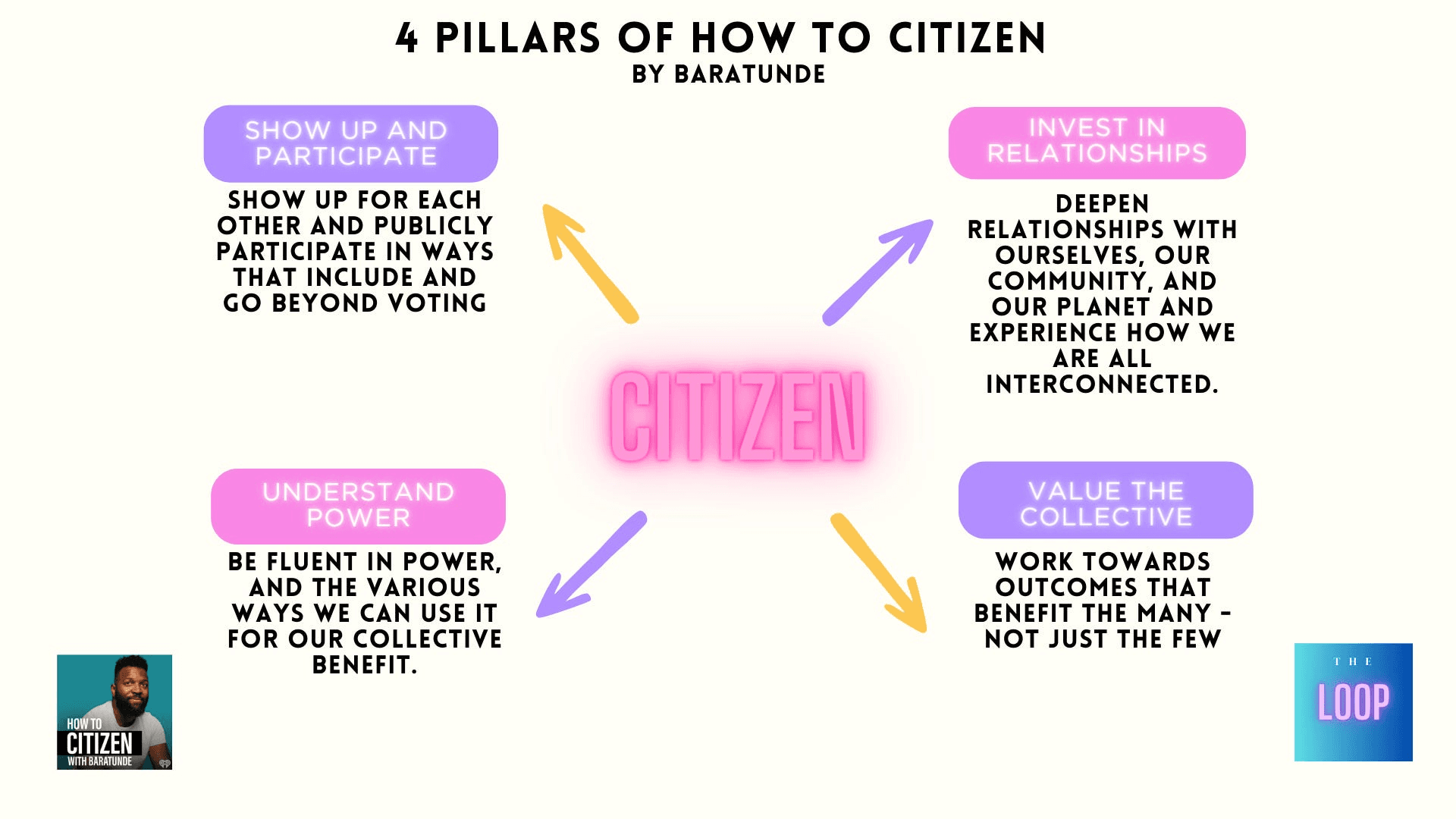
Baratunde neatly sets out four areas of thinking that can help us turn the citizen frame into tangible action, whatever role we are fulfilling and whatever system we are operating in.
A couple of examples
The small business founder
Matt Greg is the founder of NOSY creative agency , which is making a name for itself through its work on purpose-driven communications.
Matt started the business because he needed an income, but also because, in his words: “I didn't want to work at an organisation which valued profit over people, so I decided to give it a punt in creating the opposite."
When Covid-19 hit in 2020 the business lost many of its clients. Matt brought the team together and created an opportunity for them to participate in the decision on what direction to take. The team committed to pursuing sustainability as its focus in operations and clients from January 2021, but rather than print that commitment on a poster, stick it on the wall and say job done, Matt has worked with the team to maintain active participation. Every few months the team is asked if they believe the business is living up to that commitment and if its clients represent the same ethos. That simple re-framing of the team as participants, rather than simply employees there to clock in and follow orders, allows them to function as active citizens within the company system. It creates accountability and empowers everyone to be part of NOSY’s purpose. Individuals shape the business, the business influences others, the industry starts to move (combined with pressure from increased legislation and demand from clients).
The judge
In 2022 while sentencing a group of Insulate Britain protestors, Judge Stephen Leake gave us another helpful example of citizenship within a system. While Judge Leake acknowledged that he was bound to apply the law, he used his position to add his voice and influence to the discussion around climate change.
“They have inspired me and personally I intend to do what I can to reduce my own impact on the planet, so to that extent your voices are certainly heard… I have heard your voices.”
As Climate Outreach acknowledged in the their 2020 report, this kind of intervention by someone in a position of power are particularly important in sparking bigger changes:
“The social influence of those in prestigious or influential positions, may be particularly important in shaping what is desirable and affect people’s willingness to cooperate on shared problems.”
The only thing that has ever worked?
Margaret Mead famously wrote:
“Never doubt that a small group of thoughtful, committed, citizens can change the world. Indeed, it is the only thing that ever has.”
I think she’s right, but we need to make sure we don’t skip over that word Citizens and what it really means.
Citizen breaks us free from being locked in the consumer mindset. Yes, where possible we can make better purchasing choices as individuals, but we can do so much more.
More News
Explore insights, tips, and trends to elevate your sustainability, circularity and climate communications.
(
Aug 5, 2024
)
Rethinking the comsumer: Part 2
Once we start thinking of ourselves as citizens, not consumers, it opens up a range of new options to contribute to systems change.
Understanding where we can have an impact as an individual can be challenging, even once we see ourselves as more than consumers, but breaking down the challenge we're tackling can help us identify and prioritise the actions we can take.
The system
What is the system you are operating within, what are the conditions it creates and what are the outcomes of those conditions? For a business that can mean thinking about its place in the supply chain or the countries it operates in and the regulations. For an individual however, it could be your job, your family or the community you live in.
The roles
Once you’ve identified the system you are operating in, the next step is to think about your role in that system and the potential to change it (including acknowledging your limitations). For example, a couple of weeks ago I bought a refurbished laptop, which had around 97% fewer environmental impacts and was around 90% cheaper than buying the equivalent model new. As a one off action it changes very little, but if I look at the system around me I can start to think about other possibilities — could my employer do this at scale for example, could we develop a refurbishment procurement strategy that could be used by others, could we celebrate the move publicly to create social proof?
The collaborations
Once you know the systemic challenges and the actors involved, you can not only understand where you can have a direct impact through, but also where you will need to collaborate with others. Taking the laptop example one step further, if I am not involved in procurement decisions for my employer, who do I need to talk to?
Tipping the scales
That sense of being able to deal with a problem as individuals is really important, not just for our sanity, but because it’s how new ideas can take hold. The Diffusion of Innovation Theory1 sets out that new ideas, products or behaviours start with innovators, the early adopters, then an early majority, then a late majority and last, but not least, the laggards.
Along that journey, individuals play a critical role. Most of us, whether we like to acknowledge it or not, are more likely to be influenced by how our friends, neighbours and family behave, than experts. Social pressure drives change better than any data. 2
Research shows that at an interpersonal level, we look to the examples of people we think are similar to us, but when we look at a larger scale, the actions of a committed minority of people can comprise a ‘critical mass’ leading to a tipping point where social conventions change rapidly to create a new normal.3
A different way of thinking
When I started writing this, I wanted to make sure that if you made it this far, you could walk away with some tangible actions. At first I thought the answer would be to talk through some specific roles, how they are nested in the citizen frame, and the agency available in that role; for example voter, student, teacher, worker, boss. But I realised we each change roles all the time — switching from one to the other, or even inhabiting multiple roles at the same time… I’m a dad, husband, frustrated musician, and aging footballer, all at the same time as being a writer, collaborator, and strategist. Those roles may impose different expectations on me and bring different value to my life, but the thing that remains (relatively) consistent is me. So rather than prescribe specific, separately artificial roles, I thought it might be more useful to set out some thoughts on creating a citizen mindset… the ideas and behaviours we can take with us into all our roles.
How to Citizen
Describing why he created the podcast How to Citizen, the writer and comedian Baratunde Thurston expressed the kind of frustration I think many of us feel:
“I’m tired of only hearing how broken the world is. And I’m tired of leaders asking so little of those of us with so much and asking so much of those of us with so little.”
Baratunde neatly sets out four areas of thinking that can help us turn the citizen frame into tangible action, whatever role we are fulfilling and whatever system we are operating in.
A couple of examples
The small business founder
Matt Greg is the founder of NOSY creative agency , which is making a name for itself through its work on purpose-driven communications.
Matt started the business because he needed an income, but also because, in his words: “I didn't want to work at an organisation which valued profit over people, so I decided to give it a punt in creating the opposite."
When Covid-19 hit in 2020 the business lost many of its clients. Matt brought the team together and created an opportunity for them to participate in the decision on what direction to take. The team committed to pursuing sustainability as its focus in operations and clients from January 2021, but rather than print that commitment on a poster, stick it on the wall and say job done, Matt has worked with the team to maintain active participation. Every few months the team is asked if they believe the business is living up to that commitment and if its clients represent the same ethos. That simple re-framing of the team as participants, rather than simply employees there to clock in and follow orders, allows them to function as active citizens within the company system. It creates accountability and empowers everyone to be part of NOSY’s purpose. Individuals shape the business, the business influences others, the industry starts to move (combined with pressure from increased legislation and demand from clients).
The judge
In 2022 while sentencing a group of Insulate Britain protestors, Judge Stephen Leake gave us another helpful example of citizenship within a system. While Judge Leake acknowledged that he was bound to apply the law, he used his position to add his voice and influence to the discussion around climate change.
“They have inspired me and personally I intend to do what I can to reduce my own impact on the planet, so to that extent your voices are certainly heard… I have heard your voices.”
As Climate Outreach acknowledged in the their 2020 report, this kind of intervention by someone in a position of power are particularly important in sparking bigger changes:
“The social influence of those in prestigious or influential positions, may be particularly important in shaping what is desirable and affect people’s willingness to cooperate on shared problems.”
The only thing that has ever worked?
Margaret Mead famously wrote:
“Never doubt that a small group of thoughtful, committed, citizens can change the world. Indeed, it is the only thing that ever has.”
I think she’s right, but we need to make sure we don’t skip over that word Citizens and what it really means.
Citizen breaks us free from being locked in the consumer mindset. Yes, where possible we can make better purchasing choices as individuals, but we can do so much more.
More News
Explore insights, tips, and trends to elevate your sustainability, circularity and climate communications.
(
Aug 5, 2024
)
Rethinking the comsumer: Part 2
Once we start thinking of ourselves as citizens, not consumers, it opens up a range of new options to contribute to systems change.
Understanding where we can have an impact as an individual can be challenging, even once we see ourselves as more than consumers, but breaking down the challenge we're tackling can help us identify and prioritise the actions we can take.
The system
What is the system you are operating within, what are the conditions it creates and what are the outcomes of those conditions? For a business that can mean thinking about its place in the supply chain or the countries it operates in and the regulations. For an individual however, it could be your job, your family or the community you live in.
The roles
Once you’ve identified the system you are operating in, the next step is to think about your role in that system and the potential to change it (including acknowledging your limitations). For example, a couple of weeks ago I bought a refurbished laptop, which had around 97% fewer environmental impacts and was around 90% cheaper than buying the equivalent model new. As a one off action it changes very little, but if I look at the system around me I can start to think about other possibilities — could my employer do this at scale for example, could we develop a refurbishment procurement strategy that could be used by others, could we celebrate the move publicly to create social proof?
The collaborations
Once you know the systemic challenges and the actors involved, you can not only understand where you can have a direct impact through, but also where you will need to collaborate with others. Taking the laptop example one step further, if I am not involved in procurement decisions for my employer, who do I need to talk to?
Tipping the scales
That sense of being able to deal with a problem as individuals is really important, not just for our sanity, but because it’s how new ideas can take hold. The Diffusion of Innovation Theory1 sets out that new ideas, products or behaviours start with innovators, the early adopters, then an early majority, then a late majority and last, but not least, the laggards.
Along that journey, individuals play a critical role. Most of us, whether we like to acknowledge it or not, are more likely to be influenced by how our friends, neighbours and family behave, than experts. Social pressure drives change better than any data. 2
Research shows that at an interpersonal level, we look to the examples of people we think are similar to us, but when we look at a larger scale, the actions of a committed minority of people can comprise a ‘critical mass’ leading to a tipping point where social conventions change rapidly to create a new normal.3
A different way of thinking
When I started writing this, I wanted to make sure that if you made it this far, you could walk away with some tangible actions. At first I thought the answer would be to talk through some specific roles, how they are nested in the citizen frame, and the agency available in that role; for example voter, student, teacher, worker, boss. But I realised we each change roles all the time — switching from one to the other, or even inhabiting multiple roles at the same time… I’m a dad, husband, frustrated musician, and aging footballer, all at the same time as being a writer, collaborator, and strategist. Those roles may impose different expectations on me and bring different value to my life, but the thing that remains (relatively) consistent is me. So rather than prescribe specific, separately artificial roles, I thought it might be more useful to set out some thoughts on creating a citizen mindset… the ideas and behaviours we can take with us into all our roles.
How to Citizen
Describing why he created the podcast How to Citizen, the writer and comedian Baratunde Thurston expressed the kind of frustration I think many of us feel:
“I’m tired of only hearing how broken the world is. And I’m tired of leaders asking so little of those of us with so much and asking so much of those of us with so little.”
Baratunde neatly sets out four areas of thinking that can help us turn the citizen frame into tangible action, whatever role we are fulfilling and whatever system we are operating in.
A couple of examples
The small business founder
Matt Greg is the founder of NOSY creative agency , which is making a name for itself through its work on purpose-driven communications.
Matt started the business because he needed an income, but also because, in his words: “I didn't want to work at an organisation which valued profit over people, so I decided to give it a punt in creating the opposite."
When Covid-19 hit in 2020 the business lost many of its clients. Matt brought the team together and created an opportunity for them to participate in the decision on what direction to take. The team committed to pursuing sustainability as its focus in operations and clients from January 2021, but rather than print that commitment on a poster, stick it on the wall and say job done, Matt has worked with the team to maintain active participation. Every few months the team is asked if they believe the business is living up to that commitment and if its clients represent the same ethos. That simple re-framing of the team as participants, rather than simply employees there to clock in and follow orders, allows them to function as active citizens within the company system. It creates accountability and empowers everyone to be part of NOSY’s purpose. Individuals shape the business, the business influences others, the industry starts to move (combined with pressure from increased legislation and demand from clients).
The judge
In 2022 while sentencing a group of Insulate Britain protestors, Judge Stephen Leake gave us another helpful example of citizenship within a system. While Judge Leake acknowledged that he was bound to apply the law, he used his position to add his voice and influence to the discussion around climate change.
“They have inspired me and personally I intend to do what I can to reduce my own impact on the planet, so to that extent your voices are certainly heard… I have heard your voices.”
As Climate Outreach acknowledged in the their 2020 report, this kind of intervention by someone in a position of power are particularly important in sparking bigger changes:
“The social influence of those in prestigious or influential positions, may be particularly important in shaping what is desirable and affect people’s willingness to cooperate on shared problems.”
The only thing that has ever worked?
Margaret Mead famously wrote:
“Never doubt that a small group of thoughtful, committed, citizens can change the world. Indeed, it is the only thing that ever has.”
I think she’s right, but we need to make sure we don’t skip over that word Citizens and what it really means.
Citizen breaks us free from being locked in the consumer mindset. Yes, where possible we can make better purchasing choices as individuals, but we can do so much more.
More News
Explore insights, tips, and trends to elevate your sustainability, circularity and climate communications.